Dahlia Growing Basics: An Overview of How to Grow Dahlias

Dahlias are some of the most spectacular, dramatic flowering plants available to our gardens and are not hard to grow if you attend to their simple needs. I’ve written a lot here, as a detail-oriented person who loves specifics. Hopefully this article will help you in your dahlia growing!
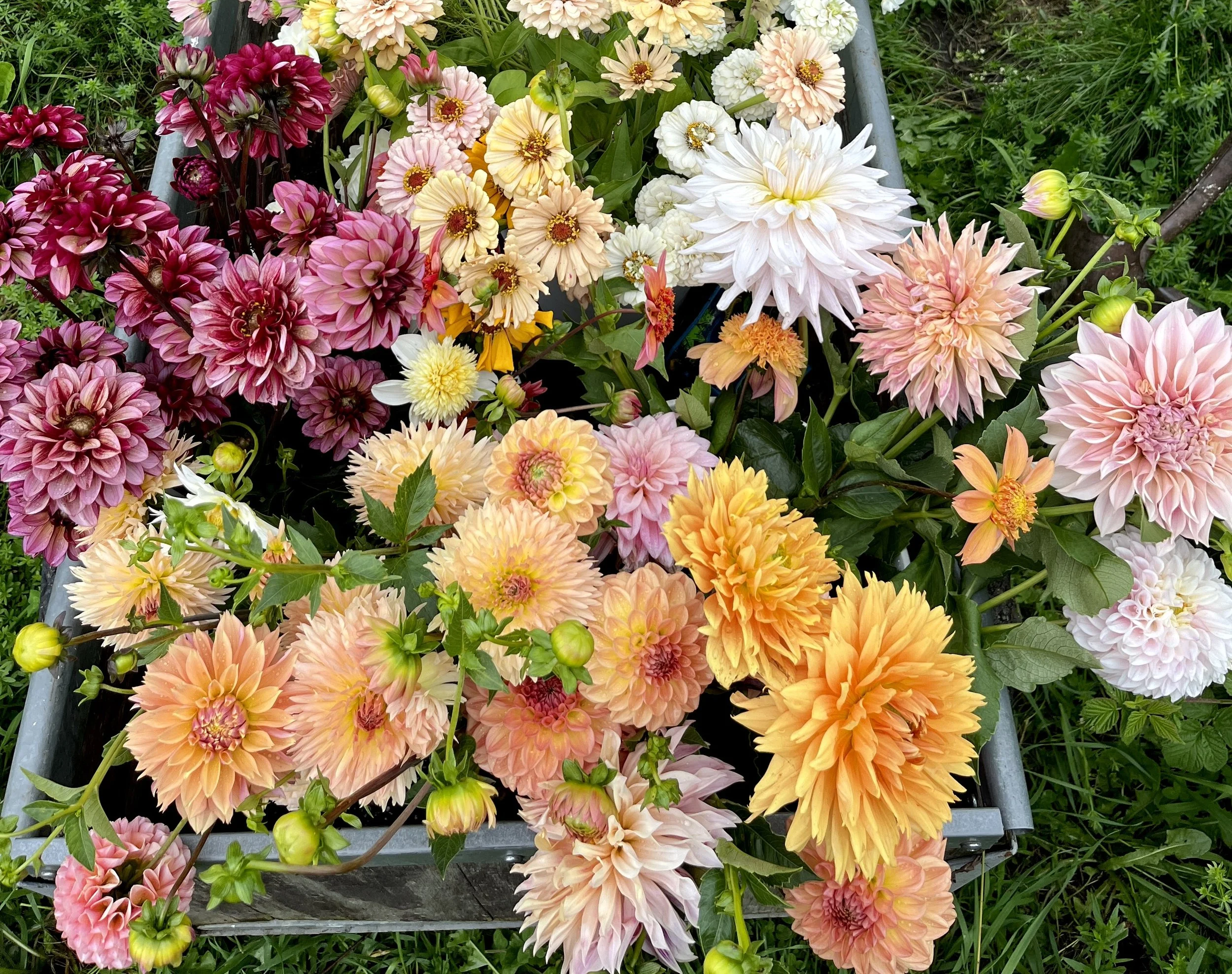
A beautiful dahlia cut flower harvest

PICKING A LOCATION: When choosing a spot to plant your dahlias, spend time observing how much light the spot receives over the course of a day during the summer. Notice what the soil is like and how fast it drains in rainstorms or in spring if you live in an area that has a deep snowpack in winter. Observing details like these about your particular spot will help you grow all your plants better, not just your dahlias.

LIGHT: Choose a spot that gets at least 6-8 hours of sun each day. Dahlias are generally thought of as “full sun” plants, but I have found as summers grow hotter here, that they do actually appreciate a bit of afternoon shade. My own garden gets 13 hours of full sun for most of the growing season, and I think it’s a little much for the dahlias. 10-12 hours of sun is probably best for these plants. I’m experimenting with placing some in a bed that is shaded for a few hours midafternoon this year to see if they prefer that. This being said, dahlias don’t do well in shade and definitely need at least those 6 hours or more of full sun to grow strongly, bloom well, and create good tubers you can store for next year.

Some interesting research (discussed in a couple different articles on the GrowerTalks website) has found that dahlia bloom time and tuber production can be modified by manipulating day length while the plants are in their vegetative growth phase. (I am working on a different blog post that goes into this interesting information and its possible implications further, and will link it here when it is ready). Be aware that if you pre-sprout your dahlia tubers or grow some from cuttings indoors, the day length you choose for them by using your grow lights is likely to affect the blooming and tuber growth of at least some varieties.

SOIL: Amend the soil with plenty of well-rotted compost. Dahlias are big, juicy, lush plants and they need feeding. My best dahlias have always been in heavily compost-amended soil. Contrary to popular belief, they do need fertilizer (or a LOT of well rotted compost) to grow well and bloom as plentifully as we want them to, especially when growing them for cut flowers. A balanced organic fertilizer added to the planting hole by the tablespoon (one tablespoonful per tuber) seems to get them off to a good start. I use a fertilizer called Pro-Grow by North Country Organics, but there are many similar products out there. If you are concerned about causing too much green growth and not getting enough flowers, go with a “tomato” type fertilizer. Definitely don’t use fresh manure on them as that will provide way too much nitrogen and delay bloom, as well as potentially injuring newly grown, tender roots.

They like good drainage and are not a plant to put in a spot where water accumulates on the soil surface during wet periods. Dahlias will grow fine in clay/rocky clay (my soil is rocky clay) but I have learned to avoid the heaviest clay soil areas of my garden when planting them because it tends to make them produce huge, tightly clustered and convoluted tuber clumps that are almost impossible to dig and wash. I find that after years of adding compost and other organic matter to my soil, it’s much easier to dig and clean the tubers in fall since the soil layers they are growing in are looser. If you have sandy soil, you’re also going to want to add a lot of organic matter so enough moisture is available to them consistently.

WATERING: Dahlias need a lot of water, once they have started to grow. Initially upon planting, DO NOT WATER in your tubers unless the soil is actually powder dry, since excessive wetness around a dormant tuber without roots will frequently cause it to rot. But once the plants emerge above the ground, they need regular watering unless it rains enough to soak the soil 4” down or more, once every several days. I think it is best to water them a couple times a week, deeply, so that the soil all around the roots is very moist when you are done. I like drip irrigation for this, but some growers swear by different sprinkler systems for overhead watering. Use what you have and what works best for your garden and life.

TUBER PLANTING: Plant outdoors close to your last frost date. All parts of the dahlia plant, including the tubers, are frost sensitive and will die if exposed to temperatures below freezing. Around when the lilacs bloom in your area is about the right time to plant dahlias. Soil temp should be around 60* F.

Plant tubers 2-5” below the soil surface, eye/former stem end up or with the tuber lying horizontally if you are not sure which way is up. Add a tablespoonful of organic fertilizer to the planting hole. Gently press soil around and over the tuber and again, DO NOT WATER until you see green growth sprouting above ground. Don’t worry about rain; they should be fine if it rains before their top growth appears.

Use slug bait around the new shoots— slugs & snails like to snack on them otherwise.

PLANT SUPPORTS: If you wish, you may use various plant support arrangements to keep the dahlia plants from flopping in high winds or rainstorms. In my windy garden, not all the dahlias get tall or lanky enough to require much support since the constant wind strengthens them, but an arrangement of stakes or low tunnel hoops around each bed with twine woven around and between the plants works well to keep them from hogging path space and helps ensure that the dahlias grow straighter flower stems.

If you only have a few plants, tying each to its own stake is a simple way to help them stay standing. Some larger scale growers use stakes with hortonova netting, a tough plastic net with 6” openings, to save time compared to tying them up. I use the stakes/low tunnel hoops and twine method as that works for me and I can compost the sisal or jute twine and the dahlia tops together at the end of the season. Hortonova and similar grower nettings are reusable plastic, but they are really hard to extract from a tangle of frosted, dead plant tops at the end of the season. It is also possible to find natural-fiber plant support netting that is both reusable and eventually compostable (I like Fedco Seeds as a source for this).
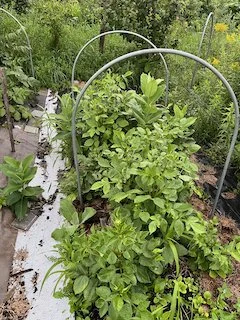
EMT low tunnel hoops in use for plant support (twine will go between them)

FLOWER HARVEST: For better flower production, cut deeply into the plant when you harvest flowers. Take a couple pairs of leaves (and sometimes a couple immature flower buds, I know, ouch) to get a nice long stem and encourage the plant to grow new, long, straight flower stems below where you took the first one. If you are selling tubers or worried about dahlia diseases, sterilize your cutting tool with bleach, veterinary sterilizing solution, or rubbing alcohol between plants.

TUBER HARVEST: There is a lot to be said about this, so it needs its own blog post, but a very simple explanation of what I do is as follows. I wait until a week or so after a hard frost has completely killed the entire dahlia plant top. The wait is so the dead top can dry a bit (less gross to handle that way unless it’s rainy the whole fall). Then I snip the stem a couple inches above the soil surface, right before I plan to dig the tuber clump. If you cut the stem and let the plant sit there in the ground like that for days, water from dew or rain will accumulate inside the hollow stem and rot the central part of the tuber clump, potentially ruining the storage ability of your tubers.
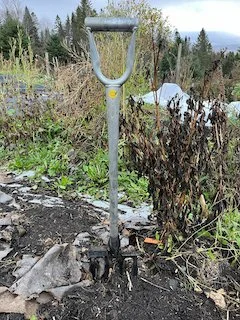
Digging fork, dahlia digging in progress
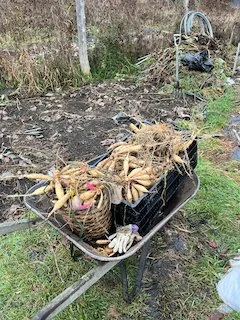
Washed dahlia tuber clumps ready to store & divide

To dig the tubers, I push a digging fork in about 8-10” away from the central stem, all the way round, gently lifting with the digging fork tines each time. When the tuber clump is freed from the roots clinging to the earth, I lift the clump and gently remove the soil by some combination of hand manipulation and gently knocking the stem stub with a tool handle to get the soil to loosen and shake out of the crannies of the tuber clump. I then wash the soil off as much as possible with the hose right there in the garden, let the clump sit until just surface dry, then place in my 43* F walk in cooler. You may have a garage or basement that stays around 40-45* F and that is a good spot to keep the tubers until you can divide them, as long as they are not set directly on concrete, which will wick the moisture out of the tubers within hours and cause them to store badly.

Again, there is more that I could say about tuber harvest and storage, but that will have to wait. When I’ve written another blog post on this subject, I will link it here.

Happy Gardening and thank you so much for reading!
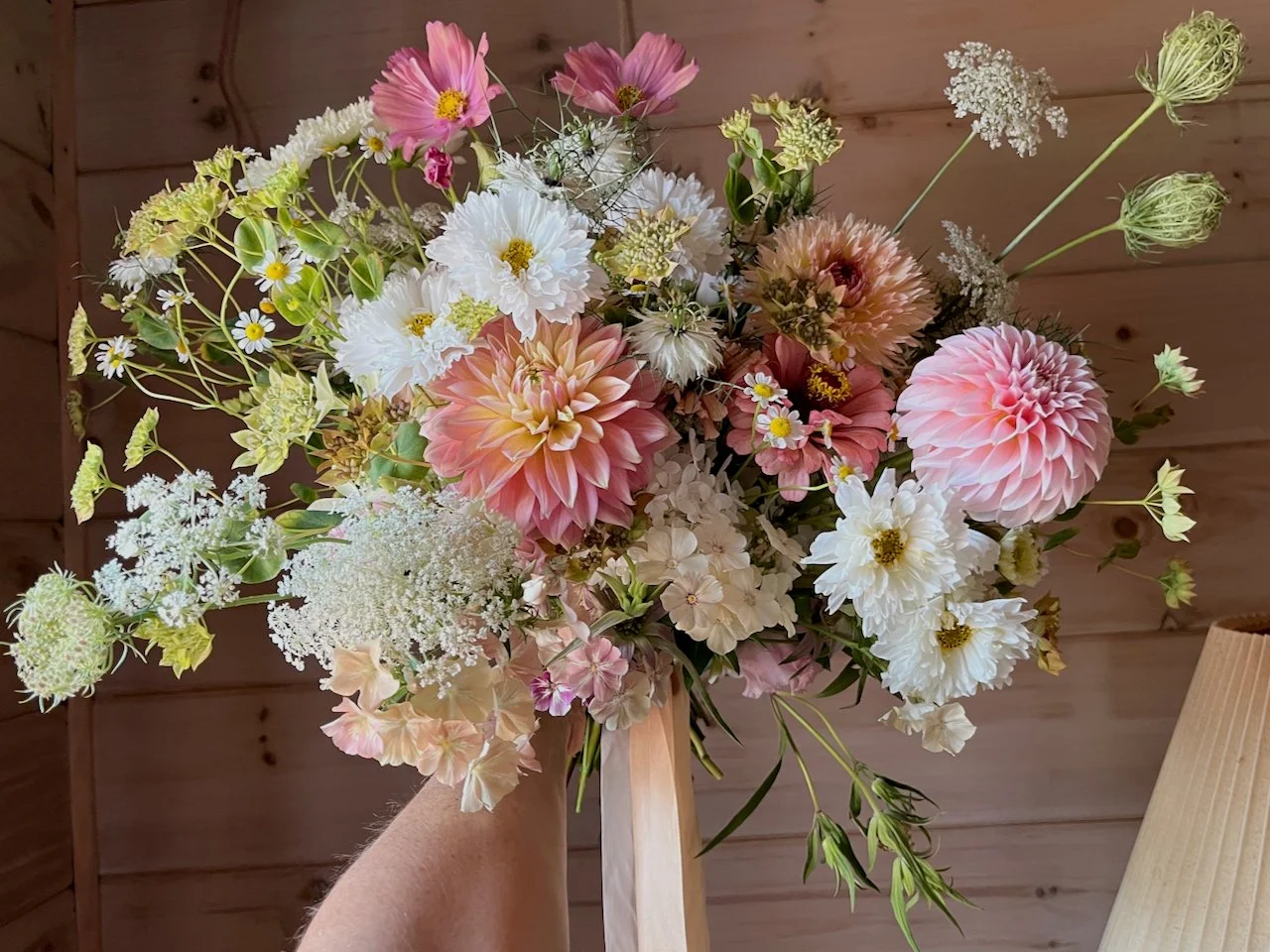
Bridal bouquet by Eva with some of the garden dahlias.
Dahlia Details: Shipping, Terms, and Growing Information

Shipping Details:

Dahlia tubers will generally ship during the month of April into the first half of May (generally, by May 10 at the latest unless your order is received close to or after that date). Orders are shipped in the order they were received and with an eye on the nationwide weather maps. We mainly ship in April because we are concerned that tubers going to northern destinations with climates like our own, might freeze in the recipient’s mailbox during the day or if getting the mail is missed that day. However, if there’s a warm spell in late March we will start shipping then.

Orders received in late April until our tuber shop closes for the season in May, generally go out within a few days of when the order was placed.

You’ll receive precise shipping information and a tracking number when your order ships out. Please be attentive to all sections of your inbox— for the email address you gave us at checkout! That is where your shipping notification with tracking will be delivered.

Upon the arrival of your tubers, unpack them and check for damage. It’s common for sprouted eyes to break in shipping, but each eye is capable of producing new shoots even when a shoot breaks off at the base, so your tuber should be fine.

Tubers will be shipped packed together in a compostable plastic zip bag and wood shavings, inside a padded shipping box. Your order packing slip will help you identify your tuber varieties if needed— the SKU numbers on the packing slip include the variety name abbreviation we use on each tuber.

Tuber Health:

Dahlia tubers are extraordinarily resilient plant parts. They can be a bit withered, flexible, and wrinkled after a winter’s storage but will nearly always still grow. We only send out tubers that we are confident will grow if treated correctly, upon arrival.  Some of them have visible “eyes” (buds for top growth) while others may have eyes that are hard to detect until 2-6 weeks after planting in semi-moist soil. In almost all cases, every tuber we sell will grow if cared for correctly. We have become expert at seeing even very dormant dahlia eyes and look for them on every tuber we pack. We also check very carefully for rot on each tuber we pack.

We are extremely careful to cull for disease if anything funky appears during the growing season, and sterilize cutting tools with rubbing alcohol between each plant during pinching, flower harvest, and tuber division.

Tuber Shape & Size:

Tubers vary greatly in size and shape according to the dahlia variety and the specific conditions the season the tubers grew. We find that tubers as small as an AA battery produce a fine, blooming plant given moist, fertile enough soil and sufficient light. Smaller tubers usually require a little extra care (fertilizing and watering) when they first sprout to provide a large, vigorous plant. Our tubers may be small or large, thin or bulbous in shape, firm or slightly spongy to the touch, smooth or rough or slightly wrinkled in texture. Sometimes our dahlia divisions will consist of 2 small or thin, joined tubers, if we have found through experience that a better plant results this way. We find that if a thick and bulbous, large tuber is longer than about 5 inches, it’s best to cut it in half, and let the end with the crown cure for a couple days indoors before planting. Large (bigger than 1.5” across and 6” long) tubers in our experience need to be trimmed like this to induce the plant to produce more new tubers instead of relying only on the single large mother tuber for more than one season.

Dahlia Terms of Service:

We sell only dahlia tubers we are confident will grow, are true to name, and free from disease. We are not responsible for customer negligence, weather conditions, postal service shipping issues, rodent damage, winter storage, or performance of plants in following seasons. 

Each tuber will grow into a full size plant that will bloom the first year under proper growing conditions. All dahlias should emerge from the soil within 3-5 weeks after planting. For any dahlia that does not emerge after 5 weeks, please dig it up and contact us immediately with photographs of the tuber, for further instructions, no later than August 1 of the same growing season. Any other concerns regarding your growing dahlias must be reported by October 1st of the same growing season. We reserve the right to request photographs before refunds will be made.

Variety Identification:

We write the variety name (or an abbreviation thereof) with a permanent marker on each tuber or tuber cluster we send out. Your packing slip includes these abbreviations plus the full variety name in each variety’s SKU number.

Tuber Storage After Arrival:

Do not let tubers sit around for long (no more than 2-3 days) before you plant unless you are already familiar with storing dahlia tubers in your particular conditions. Store dahlia tubers in wood shavings in a loosely closed plastic container, barely vented plastic bag, or cardboard box. STORE BETWEEN 40-50 DEGREES F UNTIL PLANTING and do not place them near heat sources or drafty areas. If they are stored at warmer temperatures than 50 F they will dry out, and if stored colder than 40 F they may rot. Check them each week until you are able to plant and spritz with a bit of water if they look a little shriveled, or clean off any mold that develops. If visible condensation forms in the bag or container, open it and let it air out for a day. We are not responsible for customer storage conditions.

Basics of Dahlia Tuber Planting:

Plant close to your last frost date— if you wish to push them to grow and bloom earlier, plant tubers in large (1 gallon or greater) pots in a warm greenhouse or grow room a month or two before your last frost. Be aware, however, that the roots and tubers are very quickly stunted by pot growing and will be slower to bloom if they become at all rootbound. All parts of the dahlia plant, including the tubers, are extremely frost sensitive and will be damaged if exposed to temperatures below freezing. We have sometimes planted ours a week or two before our last frost date, protecting the beds with frost blanket or mulch, as the top growth usually takes 1-2 weeks to emerge aboveground. This has worked well for us but the best dahlias we’ve had were planted in early to mid June, after last frost, and (naturally) watered heavily and often due to an extremely wet, cool summer. The later planting and more water during growth resulted in earlier bloom than earlier spring planting in dryer seasons.

Amend the soil with plenty of well-rotted compost, but do not use high-nitrogen fertilizer.

Plant tubers 2-5” below the soil surface, 10-18” apart, with the tuber lying horizontally (prevents issues if you cannot distinguish which end is the crown). Gently press soil around and over the tuber and DO NOT WATER until you see green growth sprouting above ground. Don’t worry about rain— they should be fine if it rains before their top growth appears.

Use slug bait and/or regular application of diatomaceous earth around the new shoots.

I mulch heavily with hay, last year’s grass clippings, or fallen leaves once the plants are around 8-12” tall.

For lots of detailed growing information, please consult Floret Flower Farm’s “How to Grow Dahlias” and/or Swan Island Dahlias’ growing information page.

If you have any questions, please email us!

Happy Dahlia-ing!

Dahlia Varieties Available 2020/2021

2020-2021 DAHLIA VARIETIES

UPDATE October 2021:

Dahlia tuber sales for 2022 gardening will begin sometime in mid-late January 2022. ALL sales will take place through the web shop (no separate wholesale ordering). I’ll write a new blog post in early winter with the list of varieties available in 2022.

The 2022 shop opening date will be announced to email newsletter subscribers first, then will be announced on social media.

Please sign up for my newsletter down at the very bottom of the page to make sure you’re on the list! (Newsletters are sent very infrequently and your email will NEVER be shared).

Dahlia ‘Arabian Night’

2-4 inch deep red to burgundy flowers are borne early and prolifically on well-branched, shorter plants. Flowers tend to be somewhat flat, useful for some design work. Good tuber producer.

Dahlia ‘Black Satin’

Our most beautiful and darkest burgundy (as close as “black” as a flower’s going to get) dahlia. 3-4 inch, super sturdy, rounded blooms with gracefully pointed petals are borne on lush, bushy plants with light green foliage. A later bloomer for us, but still worth growing. The upward-facing flowers hold up very well when cut— petals are thick and substantial. Moderate producer of large tubers.

Dahlia ‘Blizzard’

4 inch flowers in fresh, bright white, touched with ivory in the center. Very prolific bloomer for many gardeners. 

Dahlia ‘Boom Boom White’

3-4 inch ball-type blooms in white. Occasionally has a light touch of tan/blush in the center. 

Dahlia ‘Brown Sugar’

Fun, 4-5 inch true ball-shaped blooms in vivid, smoky paprika red-orange. Lovely super productive early blooming plants—a lot like ‘Cornel Bronze’ just in a darker and more intense shade of orange.

DahliaCornel Bronze’

3-4 inch ball-type flowers in a haunting shade of bronzy, muted orangey-peach or orange. One of our favorite varieties. Very sturdy blooms last well and hold up out of water. Large, very productive, early blooming plants. Prolific tuber producer.

Dahlia ‘Cafe au Lait’

Possibly the most famous dahlia variety of all time. 6-10 inch dinnerplate-type flowers with swirling, pointed petals in colors that vary from blush pink to tan to pale mauve, depending on growing conditions. Our plants produce flowers in the whole color range possible for the variety, changing a bit from year to year depending on the weather (we think). Very large, lush plants are slow to bloom but not the latest dinnerplate variety we’ve tried by any means. Somewhat finicky grower but nothing beats the color and shape of these flowers. Normally a great tuber producer.

Dahlia ‘Golden Scepter’

A favorite of ours. 3” ball-type blooms on long stems; a looser ball than some, giving these a more informal appearance which we love. And the color is unmatched— a perfect, delicate gold. Early blooming and fairly prolific on tall plants.

Dahlia ‘Karma Choc’

A lovely newer variety bred specifically for cut flower production, but gorgeous in a flower border too. 4-6 inch semi-dinnerplate type, velvety blooms in a rich wine red to nearly black-burgundy, depending on the growing conditions and the year. Stems are long and slender but fairly sturdy, and the well-branched plants have beautiful dark leaves and burgundy stems. 

Dahlia ‘Lark’s Ebbe’

Very beautiful 5” rounded blooms in shades of apricot, peach, and light orange. Strong long stems atop pretty compact plants. Early to midseason start to bloom. Good producer of large tubers.

Dahlia ‘Lights Out’

Velvety, deepest burgundy, super sturdy blooms about 4 inches across. A later bloomer for us (first or second week of September from a late May planting). Truly exceptional quality burgundy-black dahlia in a perfect size for bouquets. 

Dahlia ‘Lakeview Peach Fuzz’

One of our very favorite varieties, Lakeview Peach Fuzz produces 4-6 inch, very double blooms in beautiful, soft peach and apricot shades on long straight stems. Each petal is fringed at the end, giving a very delicate texture to these flowers. Prolific, early bloomer. Strong, bushy medium-height plants. Great tuber producer.

Dahlia ‘Mystique’

We love this one! 5-7 inch, round and full blooms in an exceptional shade of smoky, muted raspberry-pink. Flowers last well and are borne on long, straight stems excellent for cutting. Blooms on the earlier side, prolifically. Attractive, bushy, large dark green plants. Great tuber producer.

Dahlia ‘Noordjwik’s Glorie’

An unusual but stellar variety with 5-6 inch blooms in a wonderful starburst shape. Highly unusual, beautiful warm golden yellow with yellow-orange center. Prolific bloomer, on the early side. Long, straight stems (great for cutting) atop compact, lush plants. Good tuber producer. 

Dahlia ‘Nuit d’Ete’

A fantastic variety with “cactus-type” 4-7 inch flowers. Amazing pointy starburst blooms in deepest, rich burgundy. Prolific and early blooming. Long, straight stems atop somewhat compact, bushy plants. Produces tons of slender tubers.

Dahlia ‘Peaches n’ Cream’

Incredible, rounded 4-5 inch blooms with pointed petals curved with the utmost grace. Fabulous coloring— palest peachy blush at the petal tips, transitioning through apricot into warm, light orange deep inside the flowers. One of the most sought-after varieties; quite hard to find and well worth growing. Beautifully suited for bouquets.


Dahlia ‘Rock Run Ashley’

Amazing colors— buff, apricot, pale peach, and tan-blush— combine in this 4 inch, firm-textured, perfectly shaped bloom. One of the hardest dahlia varieties to find available— I looked for 4 years before pouncing on a few. Floret Flower Farm has made this one incredibly sought-after, and for good reason, as the blooms start early and are the perfect size for bouquets.

Dahlia ‘Sweet Nathalie’

4-6 inch, perfectly formed classic blooms in lovely shades of pale blush pink, sometimes with hints of tan or pale mauve (same colors as Cafe au Last but a more manageably sized flower). Not a super early bloomer but not excessively late for northern climates either. Strong, dark green plants.  Good tuber producer.

Dahlia ‘Terracotta’

A stunning semi-cactus type bloom, 4-5 inches across, on long stems. Peach to terracotta-rust tones with hints of lavender, or sometimes, apricot as you can see in my photo of some late-season (October/November) blooms in a hoop house. Normally they are a darker terracotta-peach all over. Highly productive. Extremely hard to find; thanks to Kelsey of West Lane Flowers for sharing this one.

Dahlia ‘Walter Hardisty’

Beautiful, finely shaped, 8-11 inch dinnerplate-type blooms in pure white with a bit of cream in the center. The best large white we’ve tried, with long, strong stems. Big, tall, lush plants. Great producer of large tubers.

Dahlia ‘White Fawn’

Prolific, lovely 3 inch flowers with a refined shape, in pure white. A particularly nice one for bouquets. 

How to Grow and Store Ranunculus

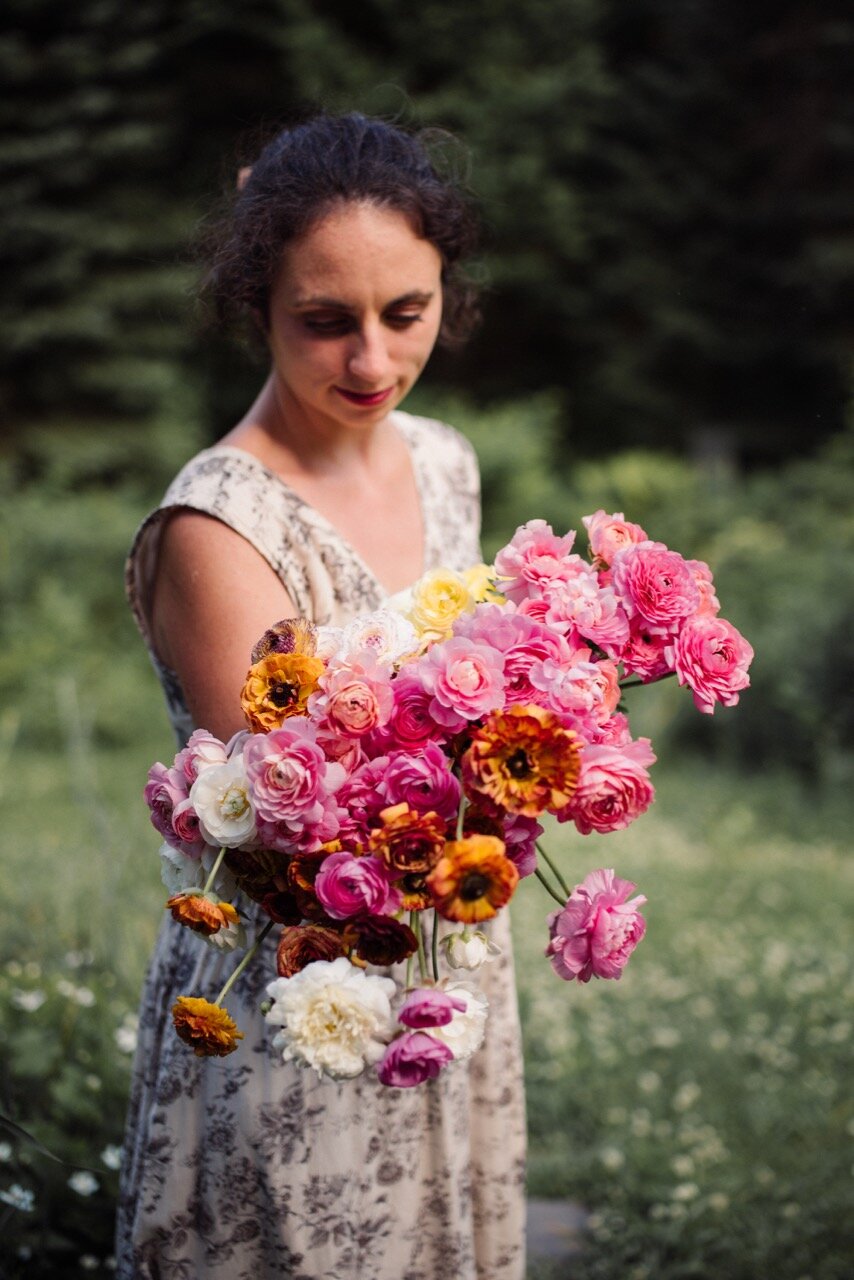
06232020-BlossomingBough-JuliaLuckettPhotography-93.jpg

Ranunculus: a perennially adored wedding and cut flower. These gorgeous, ephemeral blooms are native to the Mediterranean and Middle East, and are an early spring flower there, putting on most of their growth in the cool, damp winter months. However, like so many bulb-forming plants adapted to that region (did you know that many tulips and narcissus come from there?), they can be grown in many different climates depending on how much work the gardener is willing to do (Read on for my instructions!).

In my US zone 3/4 garden, I have found them to be one of the best cut flowers I grow, well worth the extra work they take here, where they are unlikely to survive a winter in the ground. Ranunculus are a perennial species, adapted to last through hot, dry dormant periods by storing food in enlarged root structures. When actively growing, they love the cool late spring and early summer weather we usually get where I live, in a frost pocket near the Canadian border. But, as you’ll read later, there are a number of steps to making them happy here! Because they multiply quickly when they’re happy, I sometimes have corms to share in fall and winter; check the shop page for packs of ranunculus corms to grow yourself. (Not available in winter 2021/2022 but may be back in future years).

Since I have strong local-sourcing ethic for my floral work, it’s super important to me to be able to provide these very popular, romantic flowers from my own garden for at least a portion of the weddings I work on each year. If I buy cut ranunculus flowers from the floral wholesaler, they sometimes come from Canada, but most of the time the flowers have been shipped in from South America or the Netherlands; such a long journey is common for fresh flowers in our strange, globalized world (for more on this, check out the book Flower Confidential). It doesn’t make sense to me to buy flowers coming so far, if I can grow them in my own garden for at least a portion of the year.

06232020-BlossomingBough-JuliaLuckettPhotography-121.jpg

So, I’ve had to learn how to grow enough of these beauties to supply the busy late-June and early-July wedding season I normally have. This means hundreds and hundreds of individual plants, which grow from weird, octopus-shaped food-storage structures called corms. After several years of growing ranunculus, I’ve learned a lot about how best to grow this plant. My method is outlined in detail below.

IMG_1969.jpg

How to Grow Ranunculus

Ranunculus are different than many spring bulbs (like daffodils and tulips) in that they are considered hardy only in zones 7 or 8 and south. They are grown in colder climates with a few extra steps.

Important: Plant them Right-Side Up! The top of the corm is the fuzzy/furry, lighter portion where all the root “arms” come together (you can see this in the photo of the dry corms, above, especially on the one at bottom right that’s resting at the base of my pinkie finger). Sometimes the corms still have some of last year’s stem or leaves, too. Generally the root tips point down.

Choosing a Spot in Your Garden Where They Will Thrive:

  • An area with good to excellent drainage

  • Full sun to very light shade

  • Fairly high soil fertility

  • A spot you can water regularly in dry spells after you plant them; they hate drying out when they are first forming little roots and leaves

  • In warm climates, they may need part shade

  • In cold climates with spring seasons that heat up into the high 70’s quickly, they also may need light shade or to be interplanted with taller plants (like peonies)

Ranunculus in Warm Climates: In zones 7-11, they are planted in the ground in fall for late winter or early spring bloom. They should be soaked in a shallow tray of water overnight before planting (they will swell many times the size they were when dry). If you pay attention to the type of garden spot and care they like (see “Choosing a Spot in Your Garden” above), they are quite similar in culture to most other bulbs in these warm growing zones and are likely to become perennial in a spot they like.

Ranunculus in Cold Climates: In growing zones 3-6 or so, ranunculus need to spend the winter as dry little corms (as they arrive to you in the mail) in a cool, dry spot in your house, like the spot where you store your seeds; not in the fridge or next to the furnace. Then in late winter, about 3 months before you want them to bloom and 3 weeks before you can plant them out in the garden:

  • Soak the corms overnight in a shallow tray of water; they swell to many times their dry size.

  • Plant in 50-plug seedling flats or a similar seed-starting tray, about 1 inch deep, in a good-quality potting soil. 1 corm per plug. Remember to plant right-side up (fuzzy, pale, furry spot up, root tips down).

  • Grow in a COOL (~45-60 degree F) spot in your house under grow lights, or in your greenhouse, until each corm has several small leaves. They sometimes take a week or 2 to show any leaf growth. 

  • WATER SPARINGLY but do not let them dry out! They are sensitive to both rotting from excessive wet, and drying out too much.

  • Once they have leaves and you are ready to plant them outdoors, harden the plants off outdoors for a few days before setting them out in the garden.

  • Plant out as soon as the snow melts off your garden, or as soon as nights are around 25-35 degrees F and days are in the 40’s and 50’s F. They like a teaspoonful of an organic granular fertilizer. Plant so the soil level is the same as in the plugs/seed flat.

  • Water thoroughly when you plant them; then water as needed to make sure the little roots don’t dry out completely. If it’s raining often, a soaking watering once a week should be plenty; don’t overwater.

  • They’re hardy to 23 degrees F when growing, but benefit from being covered with frost cloth if it’s in the low 20’s several nights in a row.

  • Enjoy the blooms a couple months after planting! As cut flowers, ranunculus last 2 weeks if cut when just opening and provided with clean water often. They can last 3-4 weeks (!) after cutting in the floral cooler, if kept in shallow preservative water.

  • Once temperatures go into the 80’s F, ranunculus plants will start going dormant. Flowers will go by, leaves will start to yellow and dry. Once the leaves have completely yellowed, it’s time to dig the corms. Do this right away once the plants are no longer green, as voles and moles like to eat them.

  • After digging the corms, let them dry out fully (until tiny and hard/crisp) and then store in paper bags in a cool, dry location in your house.

  • Some growers in northern areas (the northern edge of the US and parts of Canada) find that they can start ranunculus corms in June, plant them out in July, and have gorgeous blooms in September, for a second crop. As a flower farmer it’s worth a try!

 How to Store your Ranunculus Corms

Ranunculus corms will store perfectly in a cool, dry spot in your house. A mouse-free place in a dry corner of your basement away from the furnace, or the same cool, dry place where you keep your garden seeds, is great.

And there you go! Good luck with your ranunculus growing, and reach out on Instagram if you have questions!

Photographs on this page by Julia Luckett

In Season in August. . .

I have been getting lots of questions about what's in season in August and September, and often hearing wishes for peonies at that time of year. . . to all the peony lovers out there, getting married in August and September, your best best for a big, gorgeous, subtly colored local Vermont flower at that time of year is the dahlia. Or some lisianthus. Peonies are almost impossible to get in late summer, but dahlias and lisianthus are booming and just waiting for your Vermont wedding flowers!

Other flowers abundant in late summer:

  • Foxgloves (from my garden anyway)
  • Zinnias
  • Cosmos
  • Snapdragons-- they come in much nicer, open double shapes and subtle colors these days
  • Larkspur
  • Amaranth
  • Orlaya
  • Sweet Peas
  • Lilies
  • Hydrangeas

The list could continue, but that's pretty good for now! One wonderful thing about Vermont weddings is the seasonality of our location. And wedding flowers in Vermont can take advantage of this beautifully. Let me know here if you want more info!


IMG_0178.jpg